ERP & CRM Systems
Unify operations, sales, and customer management with scalable ERP & CRM platforms that cut costs and improve retention.
Robust, scalable, and secure enterprise software development — from workflow automation software and internal platforms to legacy system modernization and customer-facing solutions.
Book a callWe build the software your enterprise actually needs — from ERPs that unify operations to portals serving millions of users.
Unify operations, sales, and customer management with scalable ERP & CRM platforms that cut costs and improve retention.
Secure, user-friendly portals for employees, partners, and millions of customers — boosting collaboration and engagement.
Streamline repetitive processes with workflow automation software — automated approvals, document flows, and task routing that free teams for higher-value work.
Transform raw data into actionable insights with enterprise-grade BI solutions that enable faster, smarter decisions.
Seamless connections with SAP, Salesforce, Oracle, and legacy systems — ensuring data flows without friction.
Robust, secure apps designed to grow with your business, balancing startup-speed delivery with enterprise reliability.
We provide custom enterprise software development services that remove barriers like legacy systems, resource gaps, and IT-business misalignment. As a trusted enterprise software development company, we deliver scalable solutions tailored to enterprise-level needs.
Legacy systems are difficult to maintain and incompatible with new technologies and changes in business processes, resulting in high costs and technical debt.
Legacy systems are difficult to maintain and incompatible with new technologies and changes in business processes, resulting in high costs and technical debt.
'The developer shortage has made it difficult to find and retain talent. Without the right resources, enterprises can't deliver apps fast enough to stay competitive.'
Agile offers more visibility into the app development lifecycle, but traditional approaches lead to production delays, poor app quality, and higher costs.
Clear communication is a must when building apps, but siloed departments often result in apps that fall short of the mark.


We understand enterprise challenges - from bureaucracy and legacy systems to cost control and customer retention - and build solutions that fit your ecosystem, move fast, and deliver real impact.
Large enterprises often fear that new vendors won't adapt to their bureaucracy and politics. We've learned how to align with stakeholders, governance, and existing processes without slowing you down.
Large enterprises often fear that new vendors won't adapt to their bureaucracy and politics. We've learned how to align with stakeholders, governance, and existing processes without slowing you down.
Enterprises hate "money drains" from big vendors. We design lean, maintainable systems with transparent pricing and SLA-based collaboration.
Enterprises are often slow and heavy. We bring startup-level agility while keeping enterprise-grade compliance.
Our BI, analytics, and customer-facing platforms focus on measurable outcomes: retention, revenue growth, lower churn.
Stakeholder interviews, workshops, and process mapping to align goals, KPIs, and constraints from day one.
We start building internal platforms for large European clients.
Binerals evolves into a full-cycle software partner.
Launch of strategic collaborations in fintech, healthcare, and edtech.
We redefine our brand around trust, innovation, and impact.
We grow into a trusted tech partner for startups and enterprises worldwide.
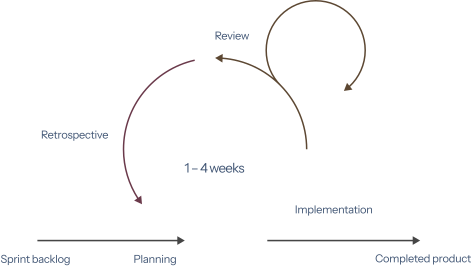
Our answer: Agile delivery with secure architecture — results in months, not years.
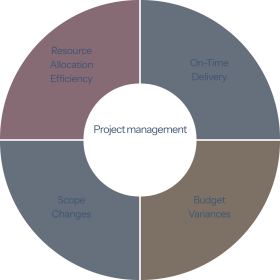
Our answer: KPI-driven development with measurable impact on retention and cost.
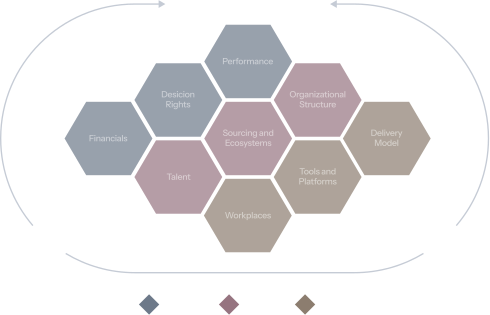
Our answer: We adapt to governance, stakeholders, and enterprise processes without slowing down.
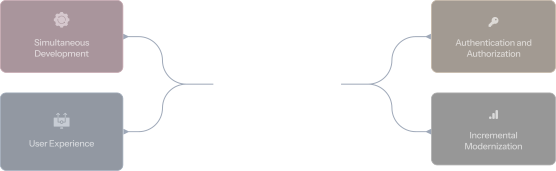
Our answer: Legacy system modernization via strangler patterns and phased migrations — so you modernize without disrupting business.
We use modern, battle-tested technology stacks built for enterprise scale, security and compliance — from legacy modernization to new platforms.
Expect only real cases and solutions tested in practice. We share real experience that helps startups and businesses grow faster.
 "AI in Software Development: Practical Integration Guide")
 "High Load System Costs: Scaling & Optimization")
 "High Load and Security: How to Protect Your System at Scale")
 "TES")
 "Building Fault-Tolerant Systems: How to Avoid Downtime Under High Load")